The two kinds of questions your agency asks all day
September 2026 · 6 min read
The short version
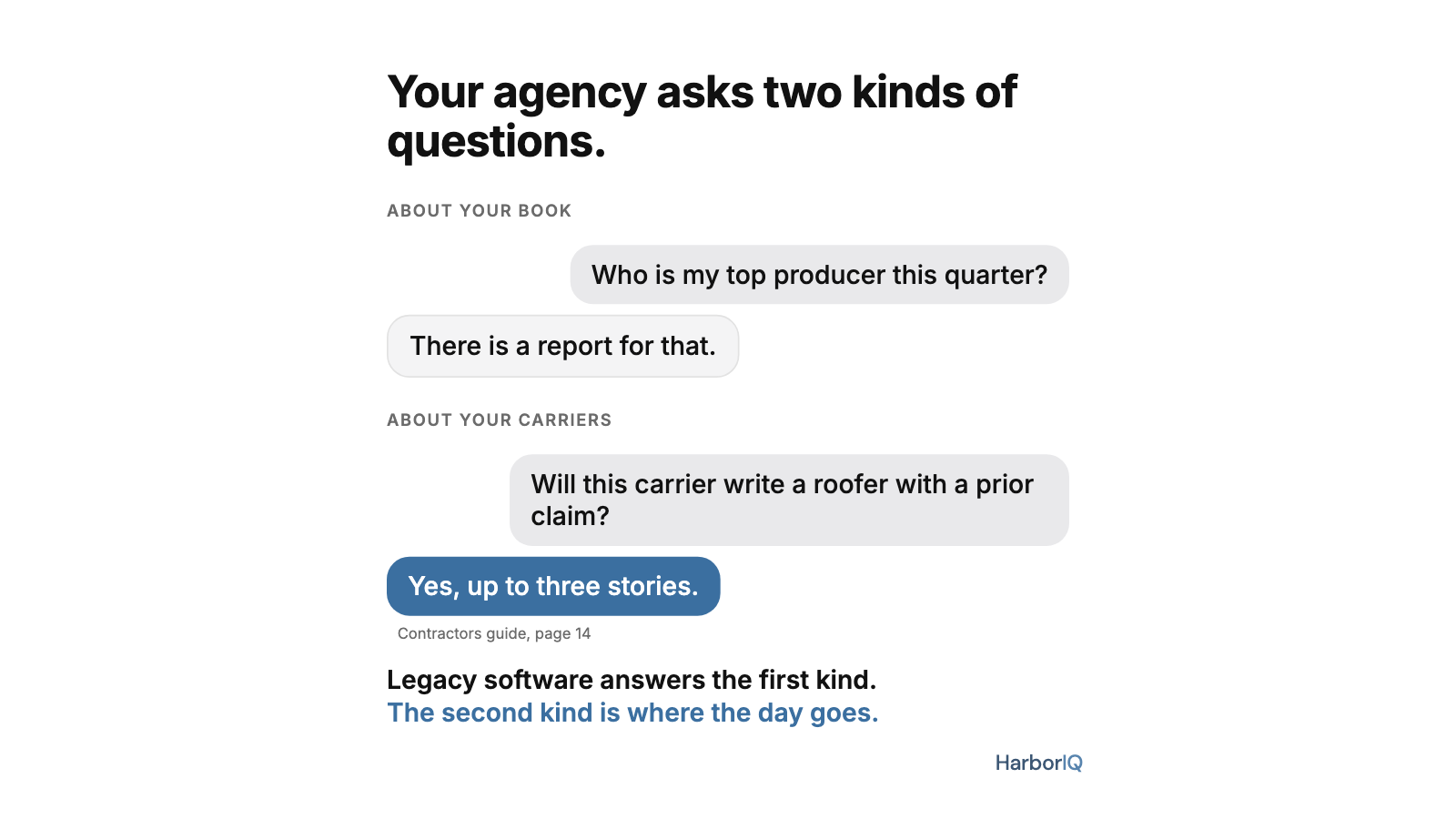
Every question in an agency is either about your book or about your carriers. Legacy management systems have answered the first kind for twenty years. They have never answered the second, so it still lives in PDFs, portals, old emails, and one person’s memory. That is where the day goes, and it is the kind HarborIQ Markets was built to answer.
Sort a few yourself. These are real questions from agency floors. Tap where each one belongs, and watch which ones the system you run today can actually answer.
Can the system you run today answer it? · Question 1 of 8
“Who is my top producer this quarter?”
What are the questions about your book?
Who is my top producer. Which clients renew in sixty days. What is retention on commercial lines. These are questions about data you already own, and your management system has had a report for each of them for years. A newer wave of AI tools lets you ask them in plain English instead of building the report, which is useful, and most of those tools are built and priced for large brokerages with an analyst to run them.
This kind of question has one more thing going for it. It is rarely urgent. Nobody is on hold while you look up your retention rate.
What are the questions about your carriers?
Will they write a roofer with a prior claim. What is the roof age limit. Which of my markets takes a vacant property. Did their coastal appetite change. Who is the underwriter, and what is the direct line. None of that is in your book. It is in an appetite guide from last spring, a portal behind a password, an email thread from an underwriter, or the head of the person who has been at the agency longest.
These questions are almost always urgent, because a client is usually waiting on the other end of them. One agency owner put it to us plainly on a call last week: “We have so many MGAs. Who’s got that appetite?” She was not describing a software gap. She was describing her Tuesday.
Why has nobody solved the second kind?
Because the knowledge was never data. A book of business is rows and columns, so software can count it. Carrier knowledge is prose: guides, bulletins, forms, and replies from people. Until recently nothing could read prose and answer a question about it, so agencies solved the problem with a person. Every agency has one. When they are out for the day, the agency gets slower. When they leave, the knowledge leaves with them.
What does a good answer to a carrier question need?
Three things. A source you can click, because an answer about appetite turns into a submission and you should be able to check it first. A date, because appetite moves. And the willingness to say “I don’t know.”
That last one came up on the same call. The owner asked our product whether a carrier writes trucking. We had not loaded that carrier’s trucking guidelines, and the answer came back saying so: no indexed documentation, no guess. It was the least impressive moment of the demo and the most important one. A confident wrong answer becomes a declined submission and an awkward call to a client. “I don’t know” becomes a phone call to the underwriter.
A fourth, which her technical cofounder raised: answers should come only from the markets you are appointed with. A directory of every carrier in the country is not an answer. The six you can actually place with is.
Do you have to replace your system to fix this?
No, and this is the part legacy workflows get wrong. The carrier question does not belong to your management system, so fixing it does not require leaving your management system. HarborIQ Markets runs beside whatever you use. Setup is a shared folder. You drop in appetite guides, underwriting PDFs, and the carrier emails worth keeping, unorganized, and it takes about thirty minutes. Then anyone on the team can ask, from wherever they are working.
The point is not the software. It is the hour it gives back. The agencies that win the next ten years will be the ones whose people have time: to call the client back, to look at the renewal before it is a problem, to sell. Be the agency that has time.
Ask your carriers a question. Get the page it came from.
HarborIQ Markets is $199 a month for 1 to 15 people, self-serve, with a 14-day free trial. It runs next to the system you already have.
Common questions
What is the difference between book-of-business AI and carrier AI for an insurance agency?
Book-of-business AI answers questions about your own data: producers, retention, renewals, revenue. Carrier AI answers questions about the companies you place business with: appetite, underwriting guidelines, eligibility, coverage forms, and who to call. They read different sources, so a tool built for one does not answer the other.
How can an independent agent find out which carrier has appetite for a risk?
Today it usually means opening carrier portals, searching appetite guide PDFs, or emailing an underwriter and waiting. A carrier knowledge tool indexes the guides and emails your agency already has, limits answers to the markets you are appointed with, and returns the answer with the page it came from.
Can I trust an AI answer about carrier appetite?
Only if it shows its source and date, and only if it is willing to say it does not know. An answer about appetite becomes a submission, so a confident guess is worse than no answer. Look for citations you can click and an explicit statement when the documentation is not there.
Do I have to replace my agency management system to use HarborIQ Markets?
No. Markets runs next to the system you already have. There is nothing to migrate. Setup is a shared folder: you drop in appetite guides, underwriting PDFs, and useful carrier emails, unorganized, and it takes about 30 minutes.